Every cityscape prompt in the library, complete and copyable from this page. Open any prompt page for the real before/after and step-by-step.
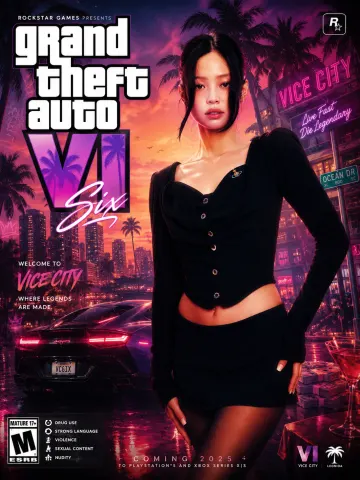
Create a highly detailed 8K portrait poster inspired by the iconic visual style of the modern Grand Theft Auto VI promotional artwork aesthetic, featuring a cinematic urban atmosphere with bold composition, vibrant lighting, layered graphic elements, and stylish contemporary street-luxury fashion energy. The overall design must strongly capture the signature mood of GTA VI posters, including dynamic neon color grading, tropical-modern city vibes, dramatic shadows, glossy highlights, stylized textures, decorative ornaments, graphic overlays, urban symbols, luxury lifestyle accents, and immersive environmental storytelling. Add premium poster decorations such as abstract shapes, graffiti-inspired accents, subtle retro-modern textures, luxury vehicle silhouettes, nightlife elements, palm tree shadows, street sign details, glowing reflections, and layered visual effects that enrich the composition without making it feel overcrowded. Include a large cinematic title text "Grand Theft Auto VI" prominently on the poster using typography inspired by official AAA video game promotional posters, with the full version of "GTA" clearly written as "Grand Theft Auto." The typography should feel bold, luxurious, modern, and integrated naturally into the poster design, supported by additional smaller decorative texts, symbols, labels, and graphic UI-style elements to strengthen the authentic game-poster atmosphere...
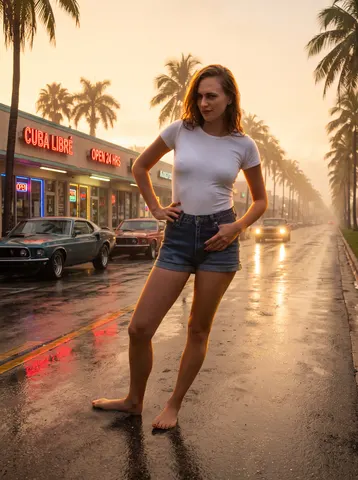
Place the person from this uploaded photo into a humid coastal city street at golden hour. Build out a Miami-style backdrop behind them — low strip-mall storefronts with glowing neon signage, wet asphalt streaked with reflected light, parked muscle cars along the curb, and rows of palm trees fading into a warm haze.

Preserve the subject's face, body proportions, pose, and clothing exactly as captured — do not alter their identity, expression, or outfit. Relight them naturally so they sit believably in the new environment: match the warm golden-hour color temperature and rim light to the scene, and add a touch of ambient bounce from the wet pavement below.

Keep the composition and camera framing from the original photo. Render the environment with photographic depth and correct perspective, not a flat backdrop — reflections on the asphalt should track the neon signage and headlights realistically. Do not smooth the subject's skin, do not stylize them into an illustration, and do not add any artificial-looking halo or cutout edge around them.

The final result should look like a single unedited photograph — a real person caught on a humid Miami side street at golden hour, neon reflections pooling on the wet road around them.
Rebuild the entire scene from the reference image as a real-time 3D render inside the GTA V Rage engine. Do not apply a filter. Fully reconstruct all people, vehicles, architecture, terrain, and props as polygonal 3D assets native to GTA V. The result should look like an authentic in-game screenshot captured on a high-end PC, ultra settings enabled. All subjects must be converted into clearly modeled geometry with visible polygon structure, baked normal maps, and game-ready textures. Faces, bodies, and clothing should follow GTA V character proportions and anatomy, slightly exaggerated, rigid, and digitally sculpted. Skin is matte and textured, no photographic pores. Hair is clumped, card-based, slightly stiff. Clothing uses flat fabric shaders with visible seams and texture repetition. Environment must feel like Los Santos or Blaine County logic. Buildings are modular, edges slightly sharp, surfaces tiled and optimized. Roads, sidewalks, vegetation, street props, and background elements are simplified but dense, clearly game-built constructed. No real-world photographic depth or lens artifacts. Lighting follows GTA V real-time lighting behavior. Strong directional sunlight or overcast skylight depending on scene. Hard shadows with defined edges, subtle ambient occlusion in corners. Reflections are screen-space and imperfect. Colors are slightly saturated with the recognizable GTA V color grading. Contrast is controlled but punchy. Materials must read as video game assets. Asphalt is flat and grainy. Metal has simple specular highlights. Glass is clean with limited reflection depth. Vegetation is slightly stiff and stylized. Nothing should appear physically accurate or cinematic-render realistic. Camera should feel like a gameplay or Rockstar Editor capture. Third-person or free camera perspective. Slight wide-angle distortion. Stable framing. No depth of field blur. No motion blur unless minimal and engine-based. Overall look is unmistakably GTA V. Real-time 3D. Polygon. Textured. Optimized. Stylized realism. Clearly not a photograph.
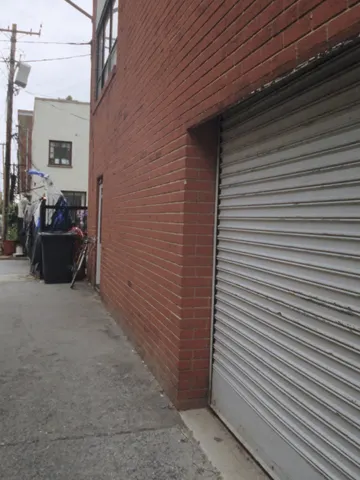
Remove all graffiti, spray-paint tags, and stickers from the walls, doors, and surfaces in this uploaded photo. Reconstruct the brick, metal, or painted texture underneath exactly as it would look if it had never been tagged — matching the original material's color, texture, and weathering precisely.

Keep the composition, camera angle, and framing of this uploaded photo completely unchanged. Preserve the lighting direction, shadows, and time of day exactly as they appear — do not brighten, flatten, or restyle the scene. Any people, vehicles, bikes, bins, or other objects in the frame must stay exactly as they are.

Do not smooth or repaint the entire wall — only clear the graffiti-covered areas, keeping the natural grain, cracks, stains, and imperfections of the surrounding surface intact. Avoid a plastic, airbrushed, or rendered look; the wall or door should still read as real material, not a flat texture fill.

The final result should look like the same street or building photo, but with every trace of graffiti and tagging cleanly gone, as if the wall had just been repainted or was never marked at all.
Remove all construction elements from this uploaded photo — cranes, scaffolding, orange traffic cones, chain-link fencing, construction vehicles, and any barriers or debris blocking the view. Reconstruct whatever the construction was covering (building facade, street, sky, sidewalk) so it reads as a complete, natural continuation of the scene around it.

Keep the composition, camera angle, and framing of this uploaded photo exactly as they are. Preserve the building's real architecture, the existing lighting and time of day, and the true colors of the scene — do not shift the color grade or add a filter.

Do not smooth, plastic-coat, or oversharpen any surfaces. Keep the same grain and noise level as the original photo, and make sure new textures (brick, glass, concrete, sky) match the resolution and detail of the untouched parts of the image, with no warped lines or blurry patches where the construction used to be.

The final result should look like the photo was taken on a day with zero construction happening — the same building, same street, same light, just clear.
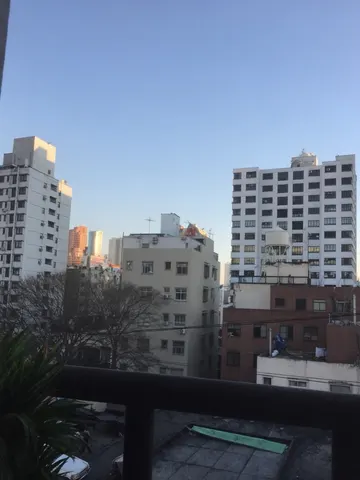
Clear the haze and smog from this uploaded photo. Cut through the thick atmospheric murk sitting over the skyline and restore crisp, true contrast to every building edge, rooftop, and antenna from foreground to the farthest tower on the horizon.

Keep the composition, camera angle, and framing exactly as shot — do not crop, straighten, or recompose the scene. Preserve the actual buildings, their proportions, and the time-of-day lighting and shadow direction; only remove the haze layer sitting between the lens and the skyline, not the buildings themselves.

Avoid over-sharpening or an artificial HDR look — keep natural color grading, authentic sky tones, and the original grain and texture of the photo. Do not smooth or plasticize any surfaces, and do not invent new buildings, signage, or details that were not in the original frame.

The final result should look like the exact same photo taken minutes later once the air had cleared — the same skyline, same light, just crisp and clean instead of choked with smog.
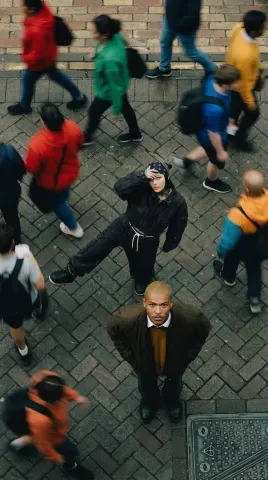
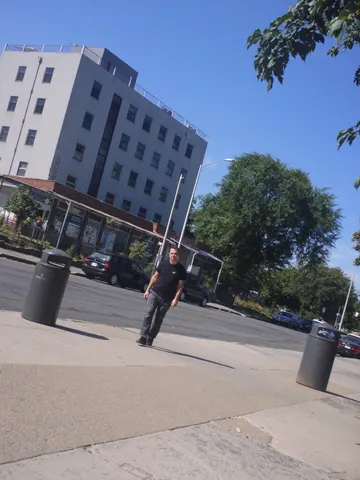
put the female model wearing black denim jacket with design, confident dynamic pose, with outfit, on the scene where the man is looking up at the camera, add more people walking on the street in different color outfits, no duplicate colors
Preserve everything about the original subject:
identical face
identical hairstyle
identical clothing
identical pose
identical body proportions
identical expression
identical camera angle
identical framing
identical lighting direction
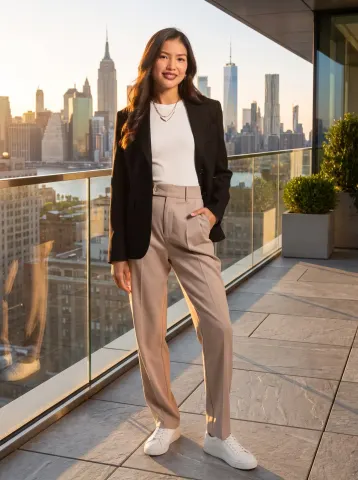
Replace only the plain white studio backdrop with a luxurious rooftop overlooking the New York skyline during golden hour.
The rooftop should feature elegant stone flooring, modern glass railings, tasteful greenery, and warm sunlight illuminating the skyline. Match the lighting perfectly so the subject naturally belongs in the new environment with realistic contact shadows and reflections.
The result should look like the photograph was originally captured on location rather than edited.
No text. No logos. No watermark.
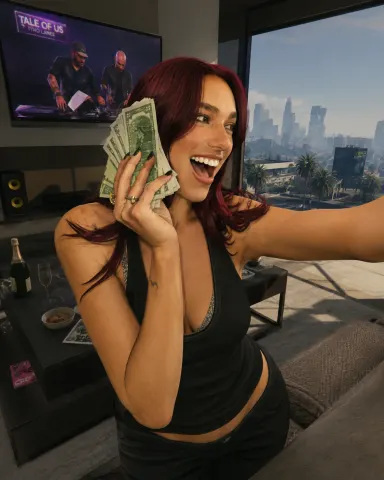
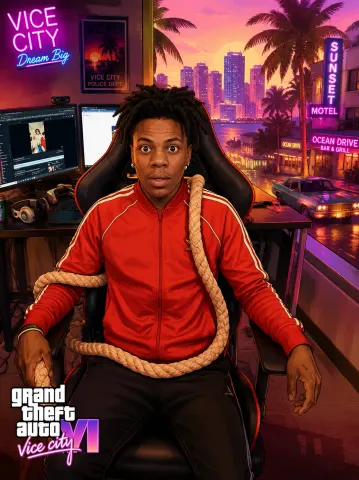
Transform the uploaded image into a high-end commercial illustration inspired by the promotional loading screen artwork of Grand Theft Auto VI and Grand Theft Auto: Vice City. Preserve the exact identity, pose, facial features, clothing, accessories, hairstyle, camera angle, and overall composition of the original photo. Reimagine the existing background rather than replacing it. Keep the original location immediately recognizable by preserving its layout, perspective, architecture, streets, natural features, landmarks, and overall atmosphere. Reinterpret the environment as if it exists naturally within the world of Grand Theft Auto VI's Vice City, enhancing it with richer visual storytelling, more stylized architecture, cinematic lighting, refined environmental details, vibrant colors, subtle signage, atmospheric depth, and immersive world-building while respecting the purpose and character of the original location. Adapt environmental elements contextually. Add vehicles, pedestrians, storefronts, vegetation, palm trees, street furniture, neon lighting, luxury details, or urban activity only where they naturally belong. Preserve the function, scale, and mood of the original setting. If the original scene is residential, rural, industrial, mountainous, indoors, quiet, or otherwise unsuited to traffic or crowds, do not introduce unnecessary cars, palm trees, pedestrians, or city elements. Every environmental addition should feel like a believable evolution of the original scene rather than a replacement Illustrate the image using